


Download a printable version of this map to bring with you on your visit to Mount Wilson Observatory!
MWO Interactive Campus Map
Click on the stars to learn more about Mount Wilson’s remarkable facilities! You can also download a printable version of this map here.

COSMIC CAFE

Mount Wilson Observatory’s Cosmic Cafe offers a variety of freshly made sandwiches and other treats and souvenirs to visitors to the Observatory. Weekend public tour tickets and U.S. Forest Service Adventure Passes can be purchased here.This location has the only public restrooms available. MORE INFO
ASTRONOMICAL MUSEUM
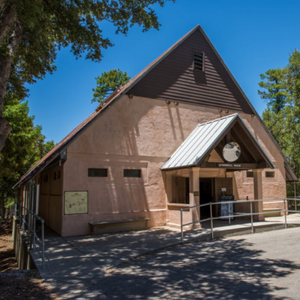
The present structure was built in 1937, replacing an earlier, smaller structure. On display are many of the early high-quality photographs taken through the observatory’s telescopes. Note the scale model of the observatory made in the 1920s. Also shown are a fly-ball governor originally used in the clockwork drive that guided one of the telescopes, one of the original mirror-polishing tools, and more. Various diagrams and brochures describe the current activities.
Hours: April 2-November 29: 10AM-5PM
December 1-March 31: 10AM-4PM
SNOW SOLAR TELESCOPE

Originally donated by Helen Snow to the Yerkes Observatory, this horizontal telescope was moved here in 1904. The telescope was the first to gauge the cooler temperature of sunspots, and the first in history to image the sun in hydrogen-alpha light. It was the largest instrument of its kind in the world between 1905 and 1908. Prior to Hale and the Snow Solar Telescope, the sun was observed by astronomers for two reasons: precision timing of the sun as it crossed the meridia, for determining local noon, and to observe the solar corona during total solar eclipses which required astronomers to travel with portable telescopes. Hale was the first serious solar physicist, and established the world’s first consistent scientific study of the physics of the sun. This telescope is still regularly used for astronomical education providing hands-on training in solar physics and spectroscopy, and as recently as 2016, it was used publicly to follow the transit of Mercury across the face of the sun.
60-FOOT SOLAR TOWER
Hale knew he needed to correct the distorted images caused by the sun heating the ground when using the Snow Solar Telescope so he built a telescope with “a high tower and no tube.” This worked by placing mirrors and a lens high above the heated ground. Astronomers could then use a large spectrograph in a pit beneath the tower where the temperature would remain almost constant.
When completed in 1908, it became the world’s greatest tool for solar research. Its vertical tower design allowed much higher resolution of the solar image and spectrum. On it, Hale achieved one of his greatest astronomical discoveries: he detected for the first time that magnetic fields exist outside of Earth. Hale observed spectral lines that were split into two or more lines, within the spectrum of a sunspot, which indicated the presence of a magnetic field. This splitting of spectral lines, known as the Zeeman effect, was discovered in laboratory experiments by Dutch physicist Pieter Zeeman (1865-1943) in 1896, for which he received the 1902 Nobel Prize in Physics.
150-FOOT SOLAR TOWER

Completed in 1912. Being the largest such instrument in the world until 1962, the 150-ft uses a novel tower-within-a-tower construction that creates a shield to minimize wind-caused vibration. Upon its completion, Hale began his work in the search for the general magnetic field of the Sun. The results indicated the probable presence of a magnetic field, but the Sun’s general magnetism was not conclusively shown until 1952 when Harold and Horace Babcock invented the solar magnetograph at the Hale Solar Laboratory in Pasadena. Today, research continues with daily hand drawing of sunspots and their magnetic fields.This has been happening since 1917, providing a valuable uninterrupted record for researchers.
60-INCH TELESCOPE

Completed in 1908, the 60-inch telescope was the world’s largest until 1917. Funding was provided from the Carnegie Institute and the large silver-on-glass reflectors established the basic design for future telescopes. The finished parabolic mirror weighs 1,900 pounds. The shape of the mirror had to be perfect to within a few millionths of an inch. The mounting and structure, built in San Francisco, barely survived the 1906 earthquake and transporting it was an enormous task, with more than 150 tons of material, pulled to the top by mule teams. Designed to operate in several different optical configurations to allow various types of research, it was the first large telescope built primarily for photographic and spectrographic use. One early accomplishment, among many, was the first measurement of the Milky Way galaxy’s size and our position in it. MORE INFO
100-INCH HOOKER TELESCOPE

Completed in 1917 and named for the industrialist friend of Hale, who helped with funding along with Andrew Carnegie, this instrument was the world’s largest telescope until 1948. With many delays due to the Great War, it took 11 years to complete the telescope and half a million dollars. It holds a 9,000-pound slab of glass that took over a year to cast. Since its completion, It has been used in every kind of nighttime astronomical research, including studies of stars, nebulae, galaxies, planets, and their satellites. The best-known, among the many discoveries made with this telescope, were those of Edwin Hubble and Milton Humason in the 1920s, proving that spiral nebulae are distant galaxies outside the Milky Way, and that the Universe is expanding. These discoveries laid the foundations of modern cosmology and led to the present Big Bang theory.
One of the most important techniques in modern astronomy is adaptive optics, which uses a small deformable mirror to correct for atmospheric distortion, providing about ten times the image resolution. Both the 60- and 100-inch telescopes have used versions of adaptive optics, proving its practicality. MORE INFO
CHARA ARRAY

Completed in 2003, the CHARA Array, operated by Georgia State University’s Center for High Angular Resolution Astronomy, features an array of six telescopes, each with a one-meter diameter mirror to reflect light. They are spread across the mountain in a Y shape to increase the angular resolution of the array. Light from each of the six telescopes is transported through newly installed fiber optics, to a special beam-combining room. There the light from all six telescopes is combined by computer-controlled optics, and a computer turns the combined light into a synthetic image. This process, called interferometry, allows the array to have the same resolving power as a telescope with a 330-meter mirror, and an angular resolution of 200 micro-arcseconds. That’s the size of an astronaut’s footprint on the moon, as seen from Earth.
CHARA has become the preeminent site for testing beam-combining technology and is the largest instrument of its kind in the world. It is particularly suited to stellar astrophysics, where it is used to measure the diameters and temperatures of stars, image features (spots and flares on their surfaces), and map the orbits of close binary companions.
CHARA OPTICAL PATH LENGTH EQUALIZATION
(not open to the public) See CHARA Array (I) for full description. This building is where all the light from the different telescopes around the mountain come together and are synthesized. It includes the beam synthesis facility, and a beam combination laboratory.
CHARA EXHIBIT HALL
The CHARA Exhibit Hall houses displays and information about Georgia State University‘s unique research conducted at Mount Wilson.
BERKELEY INFRARED SPATIAL INTERFEROMETER

Installed in 1988, this unique instrument consists of three telescopes, each mounted in a truck trailer, for making measurements of stars at mid-infrared wavelengths with high angular resolution. It determines diameters of stars and the properties of surrounding materials, such as composition, temperature, density, and distribution. Using microwave-signal-mixing principles common with radio telescopes, it applied them at the much shorter wavelengths of thermal infrared radiation. Built and operated by UC Berkeley under the direction of Charles Townes, co-inventor of the laser and Nobel Prize winner.